
Why Software Updates Are Our Most Common Support Call
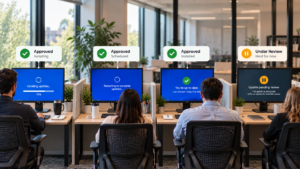
Ask our technicians what they get called about most, and the answer is updates.
It isn’t the dramatic stuff. It’s a Windows update that lands overnight, or a browser that quietly updates itself. The next morning, the program your business runs on won’t open, won’t print, or won’t talk to the thing it always talked to. Nobody did anything wrong. The software changed underneath them.
Deciding when updates install, and which ones wait, is called patch management. It’s the least glamorous part of managed IT, and it prevents more of these calls than almost anything else we do.
Why updates cause problems
Updates matter. They close security holes, and skipping them isn’t an option. But many small businesses run specialized software built for a particular version of Windows or a particular browser. When the ground shifts, that software can stumble.
It happens across the industry. Microsoft’s own release notes for the August 2026 .NET Framework update (KB5120708) describe exactly this: some Windows applications started failing to print or generate PDFs, throwing errors tied to certain fonts. Microsoft’s own workaround requires turning off part of the security fix the update was there to install in the first place. That’s the trade a business gets stuck making when nobody’s managing the rollout.
The pace is picking up, too. Google moved Chrome to a new stable release every two weeks starting in September 2026, cutting the old four-week cycle in half. Microsoft Edge is making the same shift, while Firefox and Brave are also moving toward faster release cycles. More releases means more chances for something to clash with the tools your staff use every day — and for businesses that can’t test that fast, there’s a slower official track, but most companies never hear about it or set it up.
Why the fix takes so long
When something breaks after an update, the repair sounds simple. In practice, it isn’t.
First, someone has to work out what changed, and several things often update on the same night. Then they have to find the update that caused the trouble and remove it. Then they check that the software works again, and do the same thing on the next computer, and the next. Until it’s finished, people can’t work. And unless the update is blocked, Windows may try to install it again.
We recently spent time on exactly this for a client that isn’t on one of our plans. An update didn’t agree with their main business application, and several workstations stopped working. The repair wasn’t complicated. It was slow, because every affected computer was another stop.
We wrote about a similar case, a Windows update that triggered BitLocker lockouts, if you’d like another example.
Patch management: who decides when updates install?
On a computer nobody manages, the answer is Windows. On computers we manage, it’s us, and not every update is treated the same way.
We protect your workstations by ensuring updates are assessed before they’re rolled out. That means updates are installed on a managed schedule and in a controlled manner. Why does that matter? It gives known problems a chance to surface before an update reaches your computers. Higher-risk updates can be held back, while routine updates continue to keep your systems secure.
If something still slips through, we can see exactly which computers received it, so we aren’t hunting.
No system catches everything, and we won’t pretend otherwise. A test can’t predict how every specialized program will behave. But a problem that’s held back, or contained to a few computers, is a very different day from one where the whole office is stuck.
A simple question to ask
If your computers update themselves, it’s worth knowing who decides when. We’re glad to look at how patch management works for your South Bend business and tell you honestly whether you’re exposed. If you’re fine as you are, we’ll say so.
If you’re a small business and not sure what is your current cybersecurity set up, contact us for more information. We serve South Bend, Bremen, Elkhart, Granger, Mishawaka, Plymouth & the entire Michiana region.