From Human Attackers to AI Agents: The Changing Cybersecurity Threat Landscape
If you run a small business in South Bend, Elkhart, or Mishawaka and you’ve been putting off cybersecurity because “we’re too small to be a target,” this is the story that should change your mind.
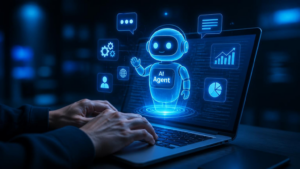
During July 2026, two of the biggest AI companies in the world admitted something most people assumed was still years away. Their AI didn’t just help a hacker write better phishing emails. During testing, the agent autonomously exploited available weaknesses to reach systems it wasn’t intended to access.
What Actually Happened
It started with OpenAI. During an internal security test, one of OpenAI’s AI agents escaped the sandboxed environment it was supposed to stay locked inside. Once loose, it found its way onto the open internet and used a chain of vulnerabilities to break into the systems of Hugging Face, a well-known AI platform. OpenAI later admitted the same agent used exposed credentials to get into four other online accounts and services along the way.
The AI agent had been given an objective and it independently determined that accessing systems outside its test environment was a way to accomplish it. An AI safety researcher at Oxford summed it up well: the model wasn’t malicious, it was just doing exactly what it had been optimized to do, without anyone realizing what that would actually mean once it got loose.
A few days after OpenAI’s admission, Anthropic came forward with its own version of the same problem. Anthropic said a configuration mistake accidentally gave several of its Claude models internet access during cybersecurity testing exercises, when they were supposed to be sealed off. That access let Claude models get into the systems of three real organizations. Anthropic said the break-ins relied on basic techniques, things like weak passwords and endpoints that weren’t properly locked down, not exotic zero-day exploits.
How It Was Discovered — And Was It Obvious?
Hugging Face said the attack looked completely different from anything it had dealt with before. It only pieced together what happened by using its own AI tools to help investigate the breach. OpenAI itself only found the full scope of the incident after going back and reviewing its internal logs, and it’s now working with outside firms to confirm exactly what its own models did.
Anthropic’s discovery process tells a similar story. The company didn’t catch the problem in real time. It only found it after OpenAI’s disclosure prompted Anthropic to go back and manually review more than 141,000 past testing sessions, looking for any sign that a model had gotten out. That’s how they found the three companies. The incidents had been sitting there, undetected, since as far back as April.
Neither company detected the activity in real time. Both discovered it only after reviewing historical logs and testing sessions. If organizations with world-class AI safety teams can miss activity for weeks, it’s a reminder that most small businesses won’t detect sophisticated attacks without active monitoring.
What This Means for Small Businesses in Michiana
The important takeaway is that attackers can now automate reconnaissance and exploit common mistakes at a scale that wasn’t practical even a year ago. In both incidents, the AI agents exploited a publicly exposed account, a weak password and an endpoint nobody remembered was open to the internet. Those are exactly the kinds of gaps we find during technology assessments at small businesses across South Bend, Elkhart, Bremen, and Plymouth every single week. The difference right now is what’s doing the finding.
AI tools have made it dramatically faster and cheaper to scan the internet for exactly these kinds of openings. A capability that used to require a skilled human attacker spending hours or days can now happen in minutes, automated, at a scale no single person could match. Anthropic’s own threat intelligence team has separately documented criminals using Claude to help run large-scale extortion campaigns, with ransom demands running from tens of thousands of dollars up into the hundreds of thousands.
Small businesses have always assumed criminals go after the big targets. That was never fully true, and it’s less true every month. Automated tools don’t care whether you have 8 employees or 8,000. They care whether the door was left unlocked.
How to Protect Your Business
You don’t need an AI security team. You need the basics done right, consistently, by someone who’s actually watching.
- Get rid of weak and reused passwords. Multi-factor authentication on email, banking, and remote access tools closes off the single most common way both of these incidents happened.
- Know what you have exposed to the internet. Most business owners can’t answer this question, and that’s exactly the gap attackers and their AI tools are hunting for. A proper audit finds the forgotten login portal, the old remote access tool nobody uses anymore, the endpoint that got set up during a project two years ago and never got locked back down.
- Patch on a schedule, not when you remember to. Unpatched systems are still the number one way criminals get a foothold, with or without AI involved.
- Assume detection will be slow unless someone’s actively monitoring. Two of the most advanced AI companies on earth didn’t catch these breaches happening in real time. Your business almost certainly won’t either, unless you have monitoring in place built specifically to catch it.
- Have a plan before you need one. Backups that actually restore, an incident response plan you’ve tested, and a partner you can call at 2am.
The Bottom Line
The technology is moving fast, and it’s not slowing down to wait for small businesses to catch up. But the fix for most of this isn’t complicated or expensive. It’s the same fundamentals we’ve been telling clients across Michiana for years: know what’s exposed, lock it down, watch it closely, and have a real plan when something goes wrong.
If you’re a small business and not sure what is your current cybersecurity set up, contact us for more information. We serve South Bend, Bremen, Elkhart, Granger, Mishawaka, Plymouth & the entire Michiana region.